
Nobody likes weather delays. Not the passengers, not the crew, not the airline. Everybody loses when a flight gets held up.
Some delays make sense the second you hear about them. Others leave you scratching your head. Let's start with the easy ones.
The Easy Ones
A mechanical delay is about as straightforward as it gets. If the flux capacitor breaks, we need a new one before we go anywhere. If a flight attendant gets hurt or can't work, we need a replacement before we can leave. (Yes, the FAA sets a minimum number of flight attendants required for a flight, based on how many seats are on board.)
Air Traffic Control Delays
ATC delays come in two main flavors.
Traffic congestion and saturation work a lot like rush hour on a city freeway. The road can only handle so many cars at once. An airliner can't just stop like a car can, so air traffic control has to manage how many "planes are on the road" at the same time. That's what an en route delay really comes down to, managing that traffic flow.
Airports can only handle so many arrivals per hour too, and that number depends on everything working the way it's supposed to: runways, approach systems, radar, all of it. Weather plays into this as well. When conditions get worse and runways have to shut down or switch configurations, the number of arrivals an airport can accept per hour drops.
The Puzzling Weather Delay
Some weather delays are easy to understand. Watching snow pile up on your airplane makes it pretty obvious. So does a call from your ride at the destination describing massive hail coming down. But what about when your airplane's sitting in the sunshine, and your ride at the other end is lounging on the beach? How can there possibly be a weather delay? What weather? Where?
Sometimes the weather is sitting right between where you are and where you're trying to go. So why not just fly around it? Sometimes you can, but the lines of weather can stretch for a long way. A flight from Chicago to Denver might have to swing as far south as San Antonio just to get around a big enough system, and that turns a fairly short flight into a much longer one. In cases like that, it can actually make more sense to sit on the ground for an hour and let the weather clear Chicago than to add hours onto the flight by routing around it.
So what happens when the area of bad weather is smaller, more of a localized patch than a wall of storms? That's when air traffic control comes back into the picture. Let's look at why.
Airplane freeways.
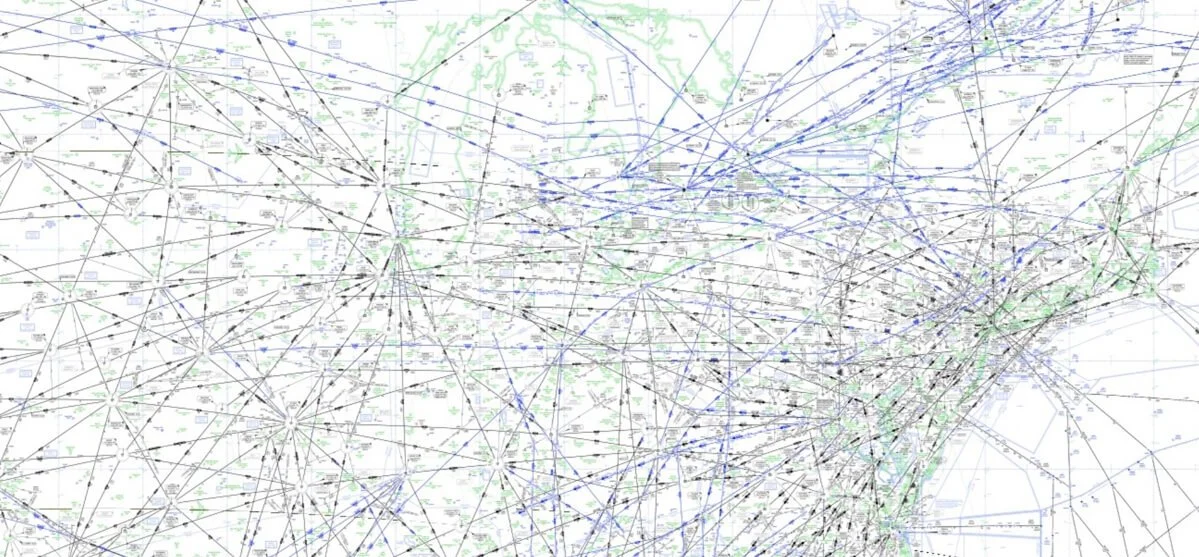
High Altitude Airways
A lot of people assume a pilot takes off and beelines straight to the destination. In reality, airliners fly a route built out of airways and navigational fixes, and air traffic control manages the traffic moving along them. Think of these airways as interstates for airplanes, except instead of lanes side by side, different altitudes stack the traffic on top of each other.
Forget whatever picture you have of a quiet interstate running through farm country. Picture the 10 freeway through downtown Los Angeles instead, on a Monday at rush hour. That's closer to what these airways look like during a busy stretch of the day.
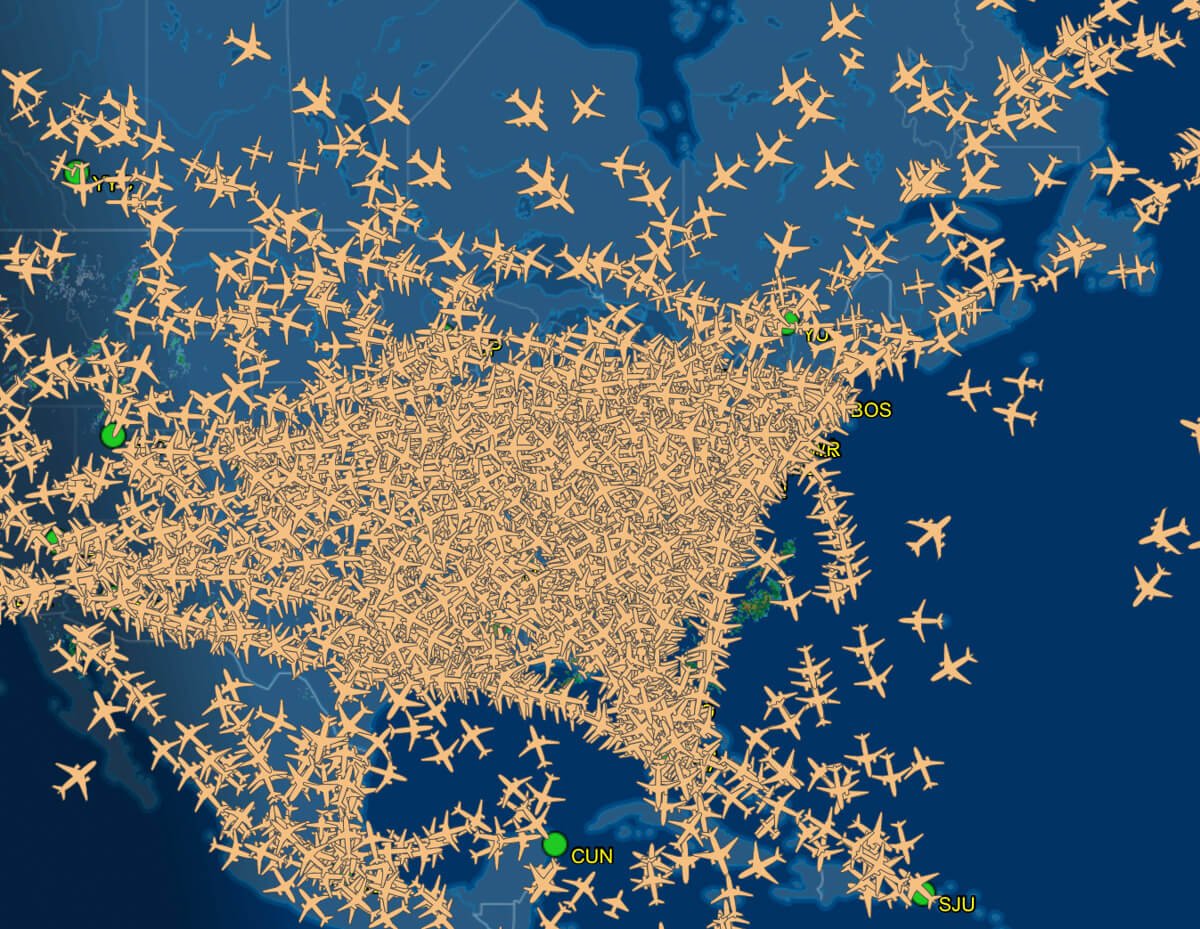
Air traffic
The picture above is a snapshot of air traffic over the United States. This is a Monday morning around 9am.
Back to our weather delay.
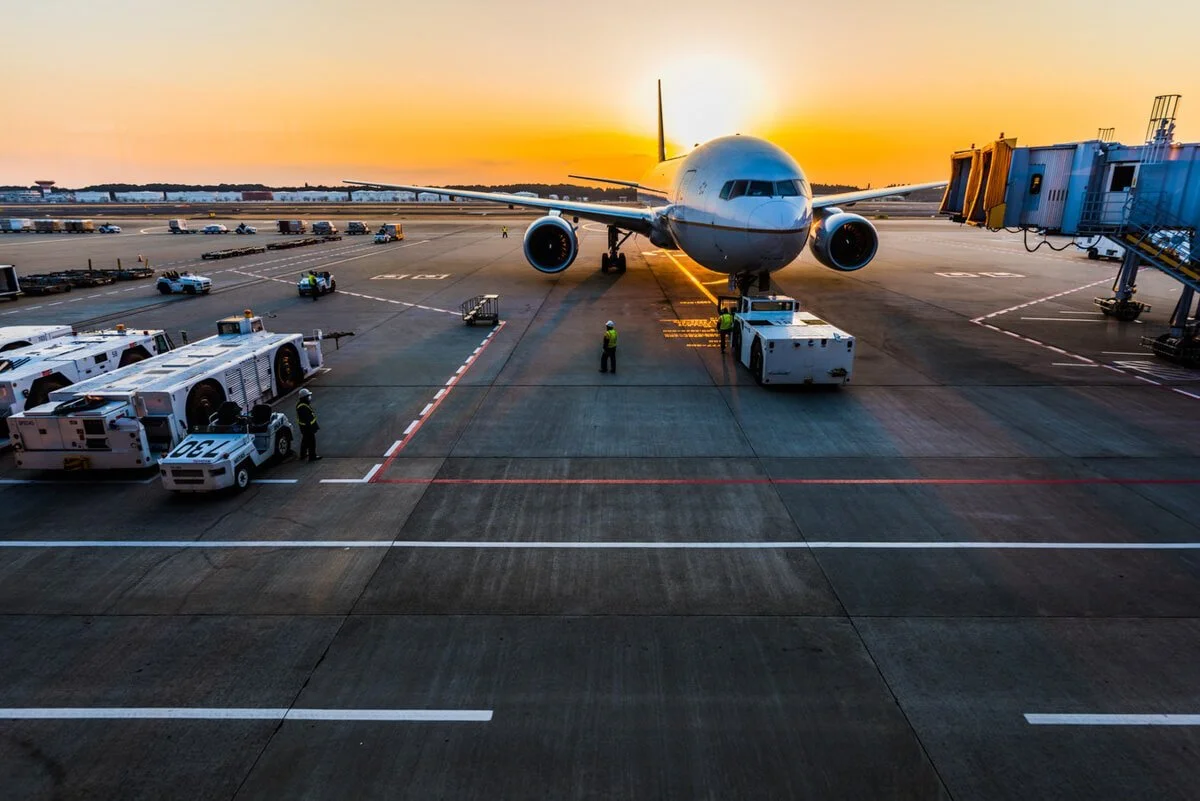
You are sitting in the terminal at Boston Logan Airport so ready for your spring break trip to Miami.
Sunny Airport
It is a bright sunny afternoon even if it is cold in Boston. Your friends arrived in Miami yesterday.

Sunny beach
They text you a few minutes ago sending pictures of themselves on the sunny South Beach. You are jealous of them when you hear the announcement your flight is now delayed 3 hours for the weather. What's happening?

Thunderstorm
There is a large area of strong thunderstorms over the Carolinas and Georgia. The weather moves in, and the storms grow. Air traffic control moves flights to airways clear of the storms. The storms shut down airway after airway. Think back to the picture of Interstate 10 downtown Los Angeles at rush hour. A colossal accident (in our case a thunderstorm) closes Interstate 10. Cars try to switch to the 91 freeway. It doesn't take long before that gridlocks.
Ground stop
A ground stop can apply to a specific destination airport or to a whole en-route region, and in this case it's the second one, covering the en-route airspace over the southeast United States. Flights are still landing in Miami, just from places like San Juan and Houston that the storms aren't touching. The ground stop is essentially a big timeout. Air traffic control is telling everyone that if your flight plan runs through the bad weather, you're not taking off. Meanwhile, airline dispatchers are scrambling to reroute your flight around it, and ATC can say no to that reroute too, usually because the new route would add more traffic than the system can handle.
When a ground stop goes into effect, air traffic control issues an update time, usually about an hour out. That doesn't mean your flight will actually go the moment that update time hits. It just gives everyone a checkpoint instead of pilots and dispatchers calling every two minutes asking if they can go yet, like kids asking "are we there yet" from the back seat. When the update time arrives, controllers look at the weather and traffic again. If things still look bad, they issue another update time, usually another hour out.
Here's the part that catches people off guard: a ground stop can end before that update time with almost no warning. That can mean a mad scramble to board and get the plane out the door. It's exactly why you don't want to wander far from your gate during a ground stop. And the fun's not over yet.
Gentlemen (and ladies) start your engines.
Once the ground stop lifts, things get interesting fast. Air traffic control can release everyone at once, which turns into a scramble to get ahead of other flights and be first in line to depart. Or it can hand out a more controlled release, one flight at a time.
That's where you might hear a pilot mention an "edict." They're not talking about a royal decree, they mean an EDCT, an expect departure clearance time. People also call it a wheels-up time, which is a pretty accurate name, because an EDCT is the exact minute you're supposed to be lifting off, not just pushing back or taxiing. If you're still at the gate or rolling toward the runway when your EDCT hits, you've missed your window, and that can mean anywhere from a short delay to a long one. Pilots really don't want to miss an EDCT, since it just pushes the delay further onto the passengers. Once a flight gets its EDCT, the crew works backward to figure out a pushback time that leaves enough room to taxi and finish preflight checks in time to make it. So if a new pushback time gets announced, don't assume the plane's going to sit around waiting on you.
Hopefully this gives you a little window into what's actually happening during a flight delay. As complicated as all of this sounds, it's really only the surface. If you want to go even deeper, check out the companion piece, Ask The Captain: Delay Complications, which gets into more of the reasoning and decisions happening behind the scenes. Had a delay that never made sense to you? Feel free to drop a comment and ask.
original publication 2019